 Institute
Established in 1999, as a Centre of Excellence in Information Technology and allied areas, the IIIT-A was conferred the Deemed University status by Govt. of India in the year 2000.
 Academics
With an enduring dedication to the pursuit of excellence, IIIT-A offers unparalleled students experiences across a broad spectrum of academic and research endeavours.
 People
The growth of an Institute depends on the dedication and hard work of all the stakeholders. IIITA has a fantastic combination of Faculty, Administrative Officers, and teaching and non-teaching staff who take care a diverse range of issues including human resources, financial activities, research ad
 Student Corner
Students are the most dynamic fraternity of the institute. They are always eager to make their mark in the world. Since its inception, IIITA has earned a worldwide reputation in fostering young minds to become successful and highly valued individuals.
 Resources
The feature of a good society is to have a well organised support system for all possible needs. IIITA offers a comprehensive set of functionaries taking care of all of its community.

Published on 09th July, 2026
2026
01
Aug
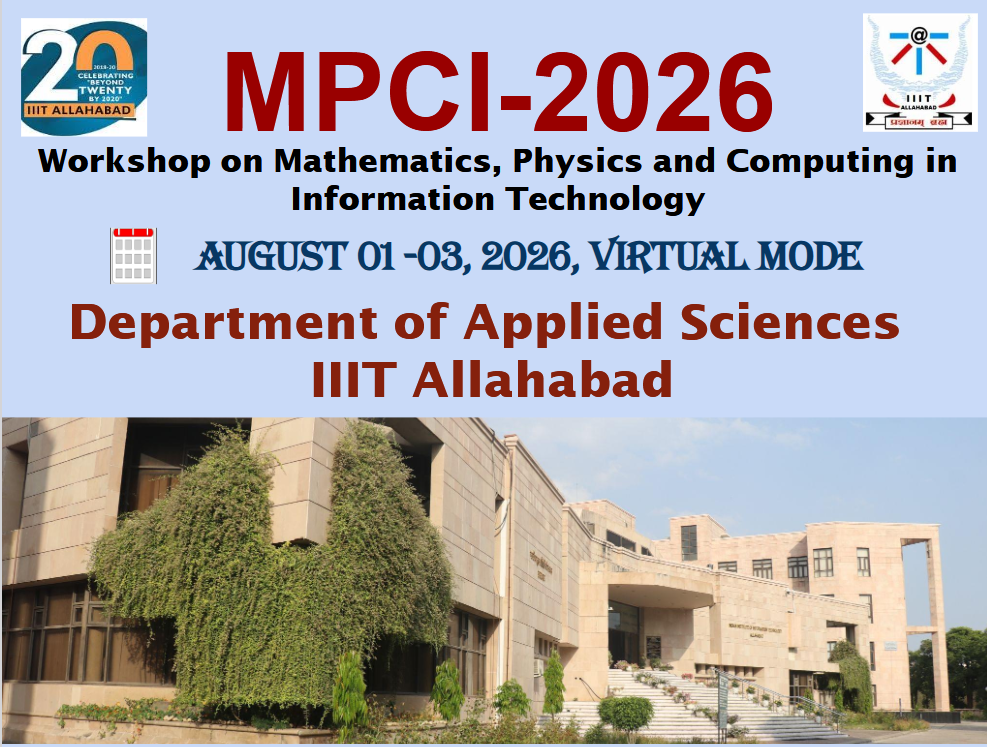
The Workshop on Mathematics, Physics, and Computing in Information Technology (MPCI 2026) is designed to provide a multidisciplinary platform for researchers, academicians, industry experts, and students to explore the synergistic integration of mathematical sciences, physical principles, and computational methodologies for advancing modern Information Technology(IT). The workshop aims to highlight how fundamental concepts in mathematics and Physics drives innovations in computing, intelligent systems, data-driven technologies, and emerging digital infrastructures. By connecting theoretical foundations with practical technological applications, MPCI 2026 seeks to foster interdisciplinary research scientific collaborations and promote advancements relevant to next-generation IT systems.
Published on 08th June, 2026
2026
20
July
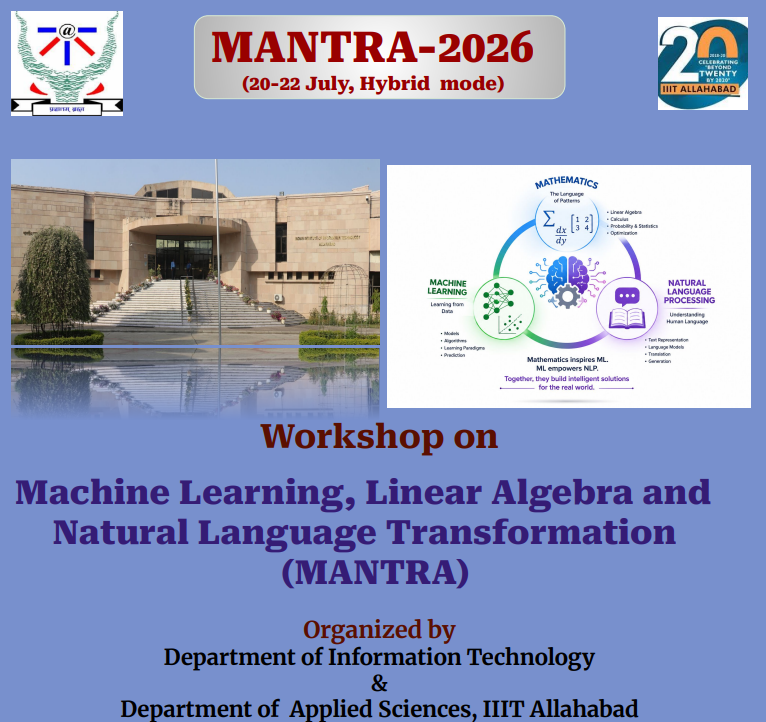
The Departments of Information Technology and Applied Sciences, Indian Institute of Information Technology Allahabad (IIIT-A), are going to organise a hybrid workshop on Machine Learning, Linear Algebra and Natural Language Transformation during July 20, 2026 - July 22, 2026. The aim of this workshop is to explore the deep interconnection between mathematical foundations and intelligent language technologies. It will focus on how concepts of Linear Algebra power Machine Learning algorithms and enable efficient Natural Language Translation systems. The workshop will provide participants with theoretical insights, computational techniques, and practical applications in multilingual AI, data representation, neural networks, and language processing. Emphasis will be placed on emerging research trends, real-world applications, and interdisciplinary collaboration in the field of Artificial Intelligence and Computational Linguistics.
Published on 08th June, 2026
2026
10
July
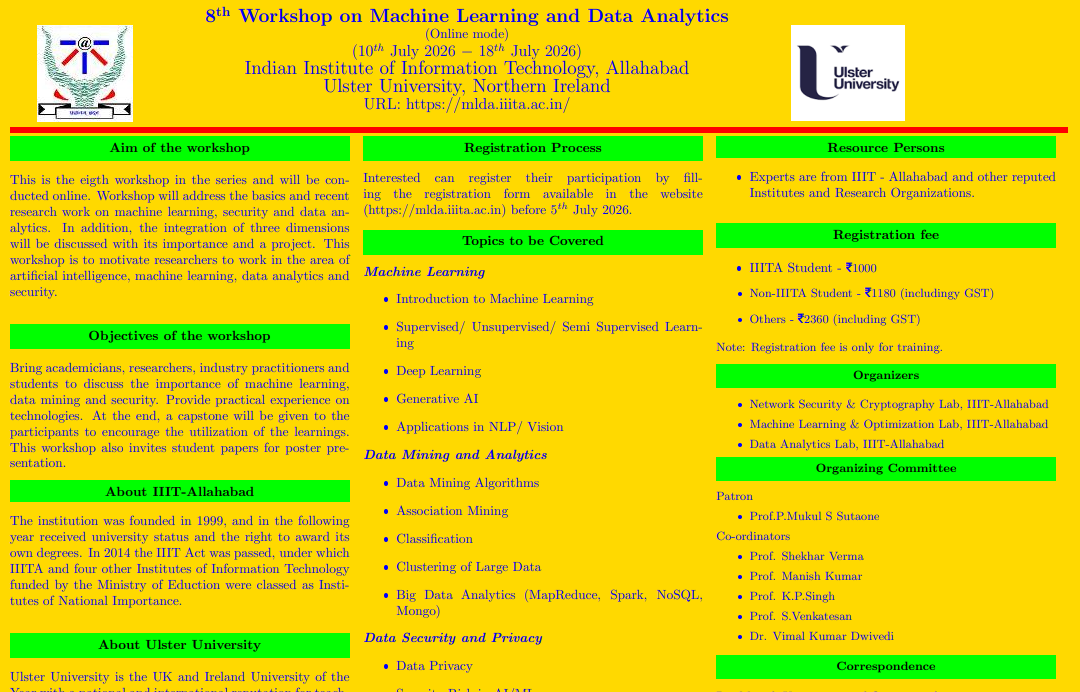
Bring academicians, researchers, industry practitioners and students to discuss the importance of machine learning, data mining and security. Provide practical experience on technologies. At the end, a capstone will be given to the participants to encourage the utilization of the learnings. This workshop also invites student papers for poster pre- sentation.
Published on 09th June, 2026
2026
01
July
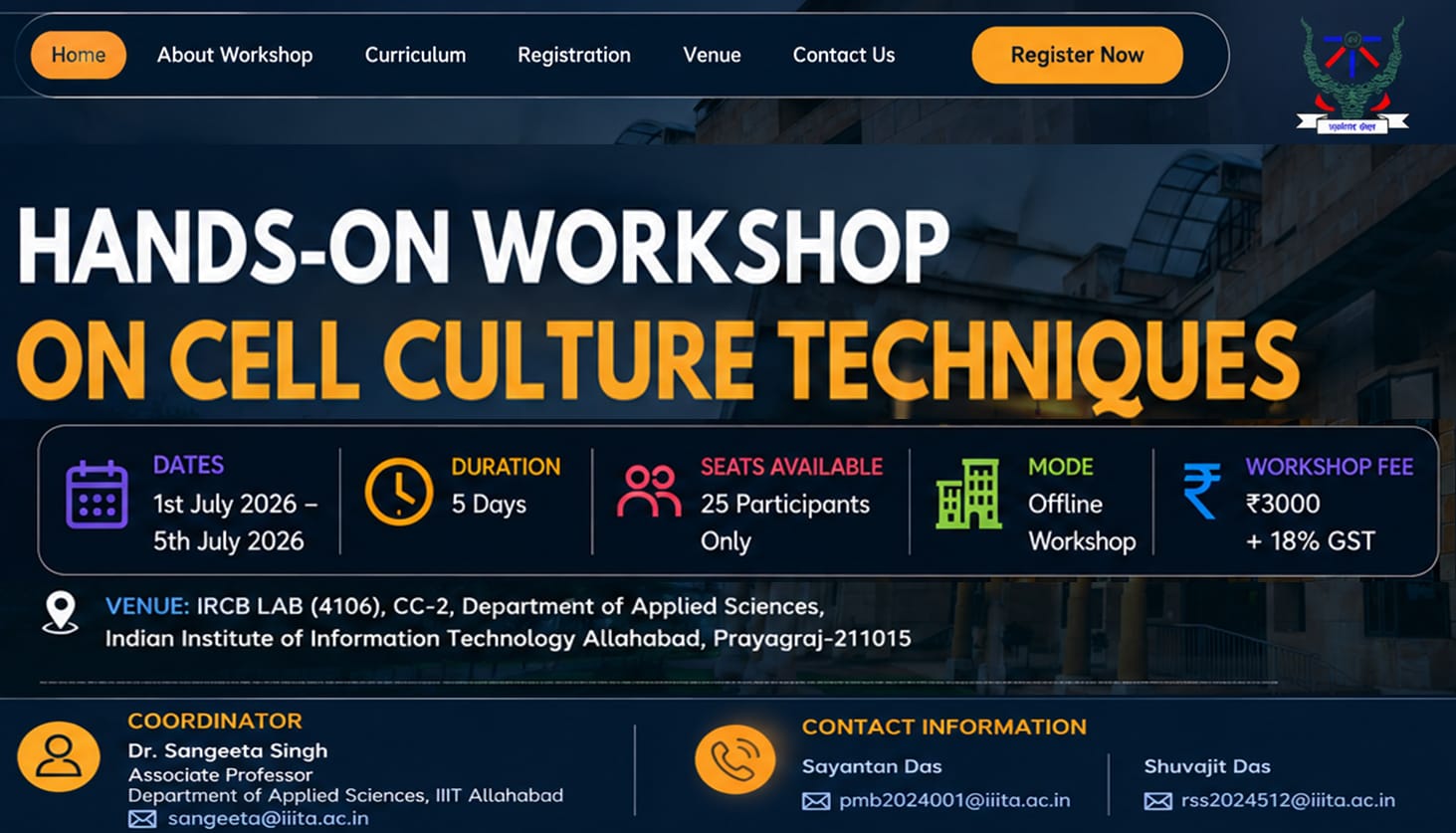
The workshop has been designed to provide the theoretical background as well as a hands-on training to students and researchers into the intricacies of handling cell culture technology:In Vitro Models for toxicity assessment. Designed for students and researchers with limited practical exposure, this course bridges the skills gap to empower your work in critical fields like cancer research, drug discovery, cancer research, regenerative medicine, genetic engineering, tissue engineering, etc
Published on 08th June, 2026
2026
01
July
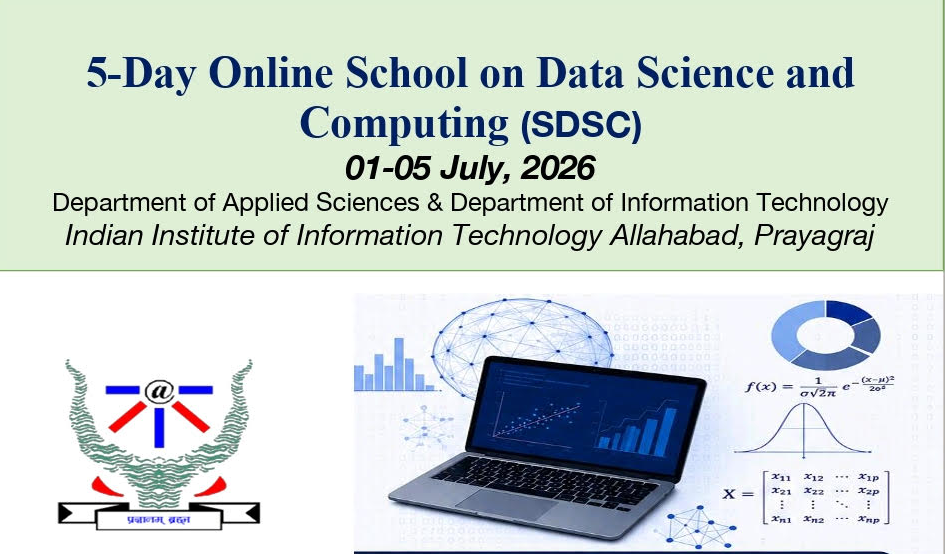
The Department of Applied Sciences jointly with the Department of Information Technology is organizing a "5-Day Online School on Data Science and Computing (SDSC). The program will take place online from 01–05 July, 2026." The 5-Day School on Data Science and Computing is designed to provide participants with strong theoretical foundations and practical exposure in data science, machine learning, computing techniques, and modern mathematical methods. The program includes lectures, hands-on sessions, coding demonstrations, and interdisciplinary applications covering mathematics, statistics, quantum mechanics & computing, statistical mechanics, algorithms, and machine learning.
Published on 13th May, 2026
2026
30
June
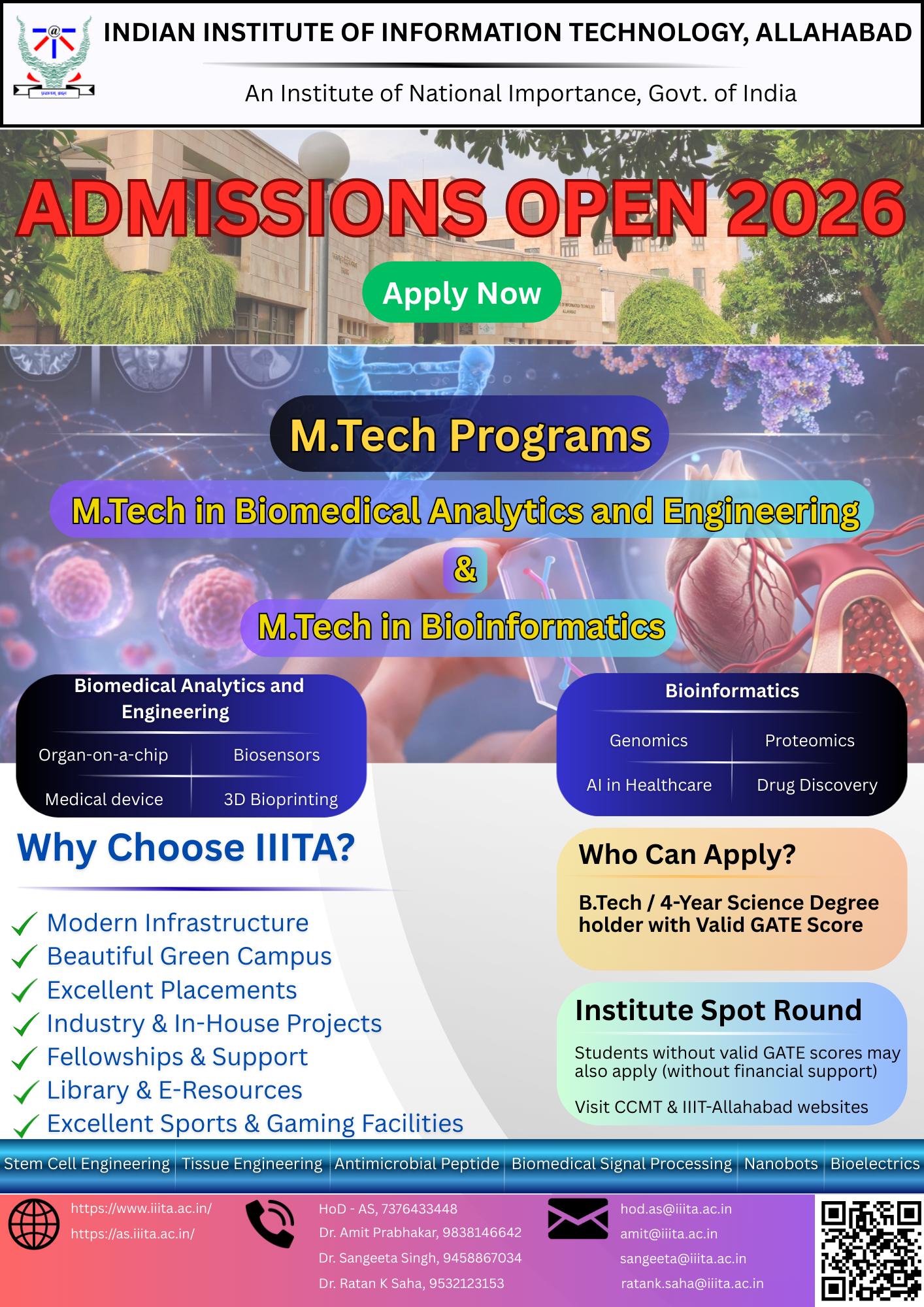
Greetings from the Indian Institute of Information Technology Allahabad (IIIT-A), an Institute of National Importance established by an Act of Parliament. We are pleased to announce that admissions for the M.Tech programs in Biomedical Engineering and Bioinformatics for the 2026 batch are now OPEN. We invite your final-year undergraduate and postgraduate students, as well as faculty members, to explore these specialized programs designed to meet the growing demands of the healthcare and life sciences sectors. The recent global health challenges have underscored the critical need for innovation at the intersection of technology and biology. There is an unprecedented demand for skilled professionals who can engineer solutions for screening, diagnostics, drug discovery, telemedicine, and advanced medical instrumentation. An M.Tech from IIIT-A equips students to become part of this vital workforce. Why Choose IIIT Allahabad? Pioneering Interdisciplinary Focus: Our programs are uniquely positioned at the convergence of information technology, engineering, and life sciences. Expert Faculty: Learn from a pool of qualified and experienced faculty members actively engaged in cutting-edge research. World-Class Infrastructure: Benefit from state-of-the-art laboratories and computational resources. Excellent Placement Record: Our graduates are highly sought after in both industry and academia. Hands-on Training: Engage in vocational training programs at partner hospitals and industries. Robust Research Support: Access in-house project facilities, financial support for conferences, and mentorship for higher education (Ph.D.). Rich Academic Environment: Choose from an eclectic collection of electives and utilize our excellent library and e-resources. Professional Networking: Be associated with the "National Biomedical Engineering Society" chapter at IIIT-A. Who Can Apply? Admissions are through GATE-qualified candidates via CCMT. Eligible Qualifying Degrees: B.E./B.Tech in any branch of Engineering or Technology (e.g., Biotechnology, Biomedical, Electrical, Electronics, Computer Science, IT, Mechanical, Instrumentation, etc.) M.Sc. in Physics, Biophysics, Chemistry, Biochemistry, Biotechnology, Microbiology, Life Sciences, or allied areas. MBBS / B.Pharm. and other allied pharmaceutical sciences. Why Specialize in Biomedical Engineering or Bioinformatics at IIIT-A? Our curriculum and research labs are designed to prepare students for the future of healthcare. Active Research Areas include: For Biomedical Engineering: Bio-instrumentation, Biomechanics, Medical Imaging, Biosensors, Neural Engineering, Biomaterials, 3D Bioprinting, Organ-on-Chip, and Telemedicine. For Bioinformatics: Drug Design, Computational Biology, Genomics & Proteomics, Biological Data Mining, Molecular Modeling, and Systems Biology. Common & Collaborative Areas: Healthcare Telematics, Bio-MEMS, Drug Delivery Systems, Bio-nanotechnology, and Biomedical Optics. Possible Career Paths After Graduation Our alumni are well-prepared for diverse and impactful roles, including: Core R&D: Biomedical Researcher, Bioinformatics Scientist, Biomaterials Engineer, Drug Discovery Analyst. Clinical & Industry Roles: Clinical Engineer, Quality Engineer, Medical Imaging Specialist, Clinical Trials Coordinator. Tech & Software: Health Informatics Specialist, Software Engineer (Healthcare domain), Computational Biologist. Emerging Fields: Prosthetics Engineer, Neural Engineer, Tissue Engineering Specialist. Strategic Roles: Intellectual Property & Patents Officer, Regulatory Affairs Specialist. Contact Us for Queries For more information or any related queries, please feel free to contact us: Head of Department (Applied Sciences): +91-532-292-2197 | hod.as@iiita.ac.in Dr. Amit Prabhakar: +91-9838146642 | amit@iiita.ac.in Dr. Sangeeta Singh: +91-9458867034 | sangeeta@iiita.ac.in Dr. Ratan K Saha: +91-9532123153 | ratank.saha@iiita.ac.in We request your kind cooperation in disseminating this information to your students and colleagues.
Published on 13th May, 2026
2026
30
June
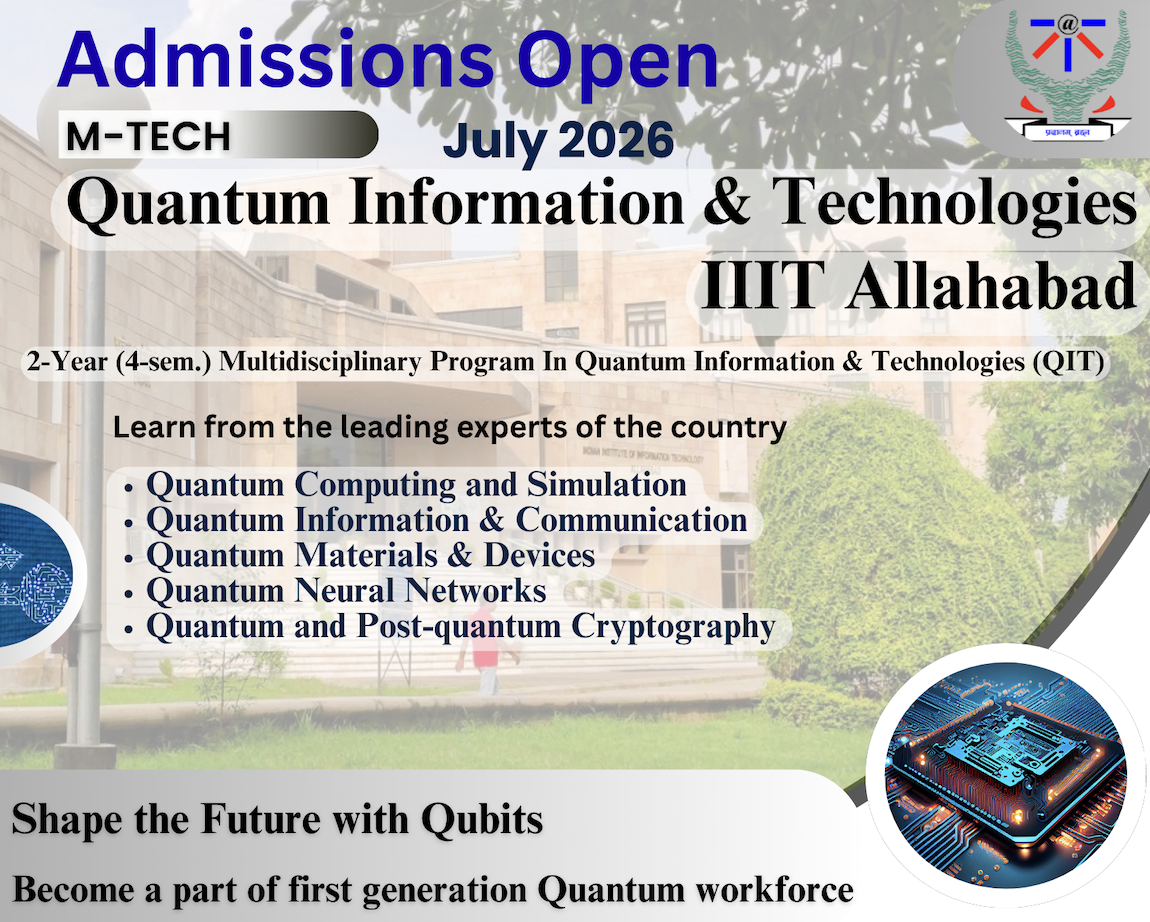
IIIT Allahabad is launching a 2-Year M.Tech Program in Quantum Information & Technologies (QIT) from the July 2026 session. It is a multidisciplinary program designed to create skilled professionals for the emerging quantum ecosystem.
Contact | RTI | Anti-Ragging Info | NetPolicy | Disclaimer | SC/ST Complaint | Developers | Sitemap
Indian Institute of Information Technology Allahabad
Devghat, Jhalwa, Prayagraj-211015, U. P. INDIA
Phone: 91-532-2922000, Fax: 91-532-2922125, Email: contact@iiita.ac.in